Can I skip the "Launching Soon" section? | Differences in performance between projects that ran a "Launching Soon" campaign on wadiz
Updated: September 8, 2026
Comparing Funding Results Based on Whether a “Launching Soon” Campaign Proceeds
and How to Use Them for Funding
“If the product is good enough, shouldn’t we just get started right away?”
If you’ve prepared both the product and the Story but have to spend another 2–3 weeks just on a “Launching Soon” page—where no payments can be processed before the main funding campaign—it might give you pause.
You can skip the project that is launching soon. However, doing so also means losing the opportunity to preview your project before the main funding campaign begins and to gather a list of people who want to be notified when it launches. While signing up for notifications doesn’t guarantee a 100% conversion to a purchase, the results generated by this simple action are more powerful than you might think.
In fact, a comparison of 20,000 projects that concluded between January 2025 and August 2026 revealed that the average funding amount for projects that were launching soon was more than six times higher than for those that didn’t. Let’s take a closer look at the data and explore how to run a launching soon phase effectively to achieve great results.
By reading this article, you’ll learn
- Performance Differences Between Projects That Were Launching Soon and Those That Skipped the Campaign
- Why the first 3 days of the main funding campaign and notification sign-ups are crucial
- How to Review Advertising and Project Information During the Period When the Project Is About to Be Launched Soon
- Can You Gather Notification Subscribers Even for Your First Project?
Pre-Launching Campaigns That Create a 6-Fold Difference in Average Funding Amount
Looking at data from projects that concluded between January 2025 and August 2026, projects that were launching soon outperformed others across all four metrics related to funding performance.
|
Category
|
Launching Soon Status
|
Launching Soon Not in Progress
|
Difference
|
|
Number of Projects
|
Approx. 22,000
|
Approx. 1,000
|
|
|
Funding Success Rate
|
80%
|
37%
|
2.1 times
|
|
Rate of raising 10 million won or more
|
24%
|
3%
|
7.6 times
|
|
Average Funding Amount
|
12.03 million won
|
1.93 million won
|
6.2 times
|
|
Average number of supporters
|
89.3
|
14.7
|
6.1 times
|
Of course, the sample size difference is significant, but projects that did not use “Launching Soon” had much lower funding amounts and supporter counts compared to those that did. Why does “Launching Soon” alone create such a large gap?
“Launching Soon” Makes the Difference on the First Day
The data makes it clear: on wadiz, the first three days after the main funding campaign launches are the most critical, as nearly half of the total results are generated during this period.
Among the approximately 22,000 “Launching Soon” projects analyzed above, the funding raised during the first three days after the main campaign launch accounted for about 53% of the total funding. Furthermore, 60% of the amount raised during this period came from payments made by users who had signed up for “Launching Soon” notifications.
In other words, the notifications you gather while the project is launching soon boost the funding campaign’s early performance.
First-day performance determines future visibility
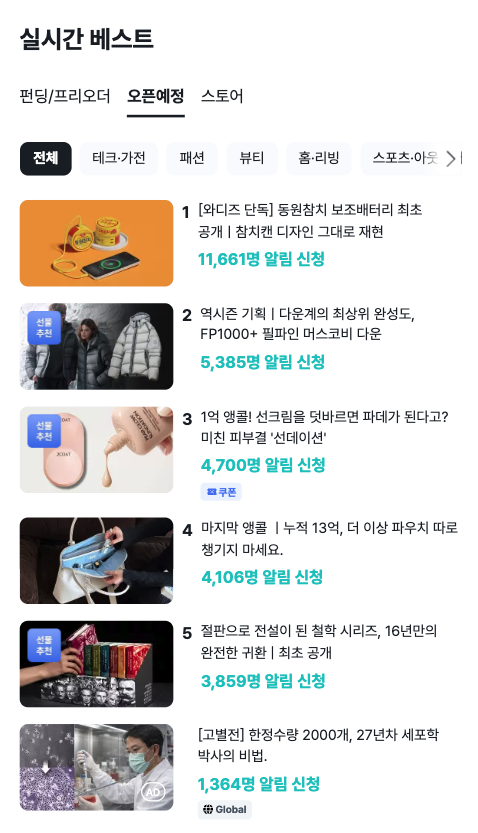
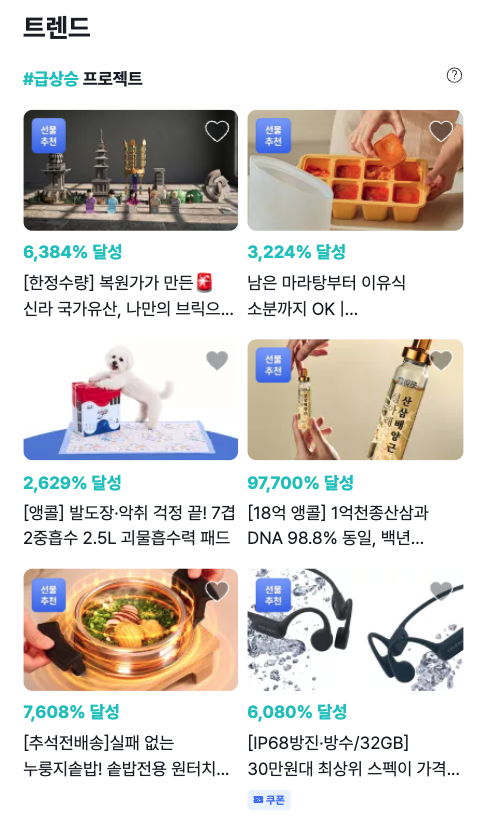
If early payment performance rises quickly, the project is more likely to be featured in the “Real-Time Best” and “Recommended” sections on the wadiz homepage—one of the areas where wadiz supporters pay the most attention. This creates an opportunity to introduce your project to new supporters who haven’t signed up for notifications.
The “Launching Soon” phase is the starting point for creating this momentum. Therefore, the goal of the “Launching Soon” phase isn’t simply to increase the number of notification subscribers, but to gather supporters in advance who will quickly participate in the funding campaign on the first day of the main funding period.
 |
 |
A Time to Test Ads and Project Information
Running ads during the period when the site is launching soon allows you to see which ad creatives are getting clicks and which target audiences are responding before the main funding campaign begins. Rather than focusing on a single ad creative from the start ,we recommend testing 3–5 different ones and keeping the two that perform best. Actual data from “Launching Soon” ads also showed significant differences.
- 97%of projects that raised 50 million won or more ran targeted ads.
- The average funding amount for projects that ran ads was about six times higher than for those that did not.
- Projects that raised 10 million won or more spent an average of approximately 2.8 million wonon targeted ads over a period of 23 days.
Running ads while you are launching soon leaves you with three key benefits even after the funding campaign ends
- Proven Ad Creatives: If you identify copy and images from high-performing creatives, you can continue to use them not only during the current funding campaign but also after it ends.
- Your Brand’s Target Audience: By identifying the specific demographics of supporters who responded to your project and signed up for notifications, you can effectively apply these insights to future advertising and marketing strategies.
- Notification Sign-up Data: For emerging brands that struggle to demonstrate data-driven results, a high number of notification sign-ups generated through advertising can serve as compelling copy and a hook. Try using data such as “Over 1,000 sign-ups for brands launching soon” on your detail page and in your ad creatives.
Even for first-time projects, an average of 1,017 people signed up for notifications
You might think, “If I’m a new brand with no fans, wouldn’t launching soon be pointless for my first project?” So When we analyzed projects that ran their “Launching Soon” phase for 10–25 days, breaking them down into new and existing makers, even new makers with no prior funding history averaged 1,017 notification subscribers. The average for existing makers was 1,083—there was no significant difference.
Wadiz supporters focus more on the maker’s authenticity and the project’s innovation than on brand recognition, so instead of feeling intimidated because it’s your first time, go ahead and showcase your project’s appeal to the fullest starting from when it’s launching soon!
Once you’ve decided to launch soon, prepare these three things
3–5 ad creatives to test
Prepare ad creatives with different messages and images, and compare their responses.Product detail pages and FAQs that address supporter questions
Address recurring issues from comments and inquiries before the main funding campaign begins.Stories launching soon and News to share while supporters wait
Highlight the product’s appeal and pre-funding benefits, and remind supporters of the main funding launch date.
Go to set your schedule for launching soon
Not a maker yet? Create your project
Frequently Asked Questions (FAQ)
Q. Does “53% in the first 3 days” refer to the first 3 days before the campaign launches or the first 3 days of the main funding campaign?
A. It refers to the first 3 days after the main funding campaign launches. The first 3 days of the launching soon period are not directly linked to the success bonus. The trend in notification sign-ups during the early stages of the launching soon period is used as a benchmark to assess how the campaign will perform for the remainder of the campaign.
Q. What should I prepare before launching soon?
A. There are three main things: 3–5 ad creatives to test, the product details page and FAQs to revise based on inquiries from notification subscribers, and the story that will be launched soon. Let’s take a look at how to write a story that will be launched soontogether.
Q. What metrics should I look at to gauge supporter demand as we launch soon?
A. You should look at the rate at which the number of notification sign-ups is increasing. This is practically the only demand signal you can check before the launch. You should also review the comments and inquiries left by those who signed up for notifications. Recurring questions are likely to be the same ones you’ll receive after the launch.